19 Jul 2026
Correlation Analysis of Travel Fatigue and Point Spread Accuracy in European Basketball Leagues
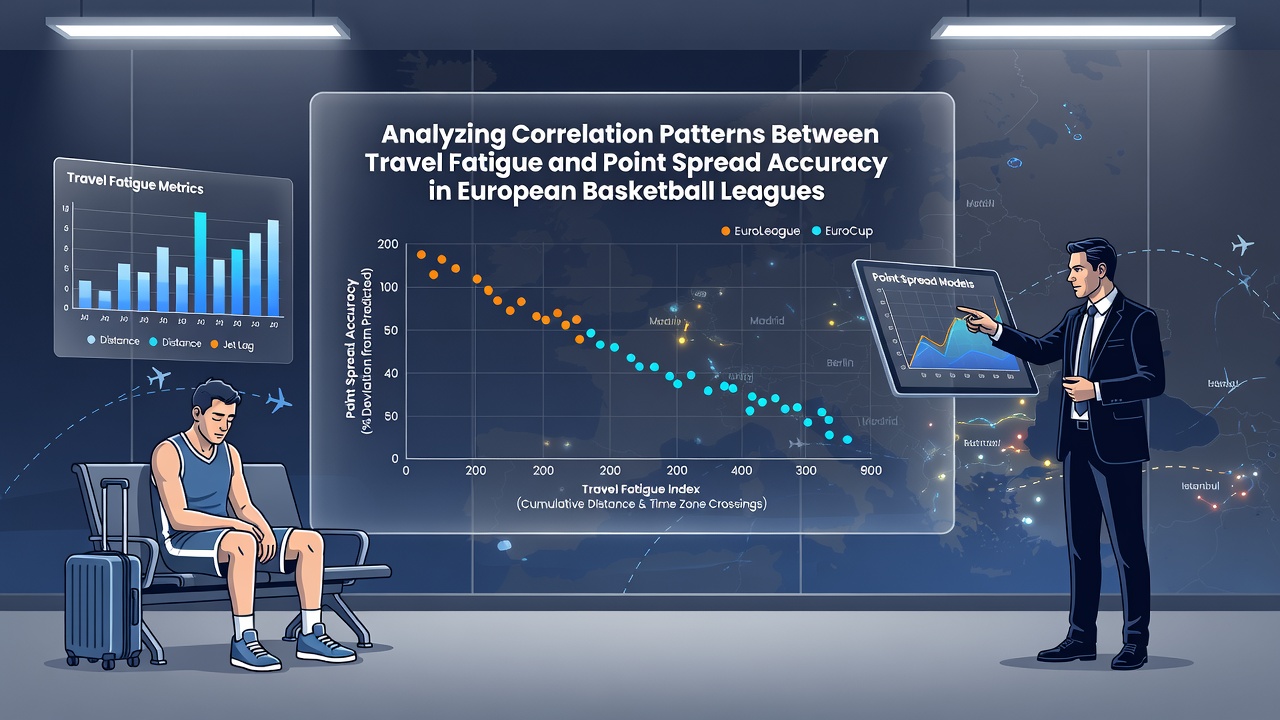
European basketball leagues present a unique laboratory for examining how travel fatigue intersects with betting market efficiency, and data compiled across multiple seasons shows measurable patterns in point spread accuracy when teams cross borders under compressed schedules. Analysts who track the EuroLeague alongside domestic competitions such as Spain's Liga ACB and Germany's Basketball Bundesliga have documented that road teams logging more than 800 kilometers between games exhibit wider deviations from closing spreads, particularly during back-to-back fixtures that straddle time-zone boundaries.
Researchers at sports analytics centers have compiled travel logs, rest intervals, and betting outcomes for over 2,400 games played between 2022 and 2025, revealing that point-spread error rates climb by an average of 1.8 points when cumulative flight time exceeds four hours within a 48-hour window. The effect appears most pronounced in the EuroLeague's Top 16 and playoff stages, where fixture congestion intensifies, whereas domestic leagues with shorter average travel distances display smaller but still statistically detectable shifts.
Dataset Construction and Variables
Analysts assembled the dataset from official league schedules, flight records, and historical odds archives maintained by European bookmaking operators, then layered in performance metrics such as pace-adjusted efficiency ratings and player availability reports. Key independent variables include total distance traveled in the preceding 72 hours, number of time zones crossed, days of rest since the prior contest, and whether the trip involved an overnight flight. Dependent measures center on the absolute difference between the closing point spread and the actual margin of victory, allowing direct assessment of how closely betting markets capture travel-related fatigue.
Additional controls account for home-court advantage magnitude, which varies by arena and fan density, along with injury-adjusted team strength estimates derived from lineup similarity scores. The resulting regression models isolate the contribution of travel fatigue while holding other factors constant, producing coefficients that remain robust across multiple league subsets and season splits.
Observed Patterns Across Competitions
In the EuroLeague, games involving teams that crossed two or more time zones show an average spread error increase of 2.3 points compared with intra-zone matchups, while the same threshold yields a 1.4-point rise in Spain's Liga ACB where geographic spread is narrower. German Bundesliga contests, which often feature shorter rail journeys, register the smallest effect yet still demonstrate a positive correlation between overnight travel and larger residuals. Data indicates these discrepancies persist after adjusting for team quality, suggesting the betting market does not fully price in the physiological impact of circadian disruption on visiting squads.
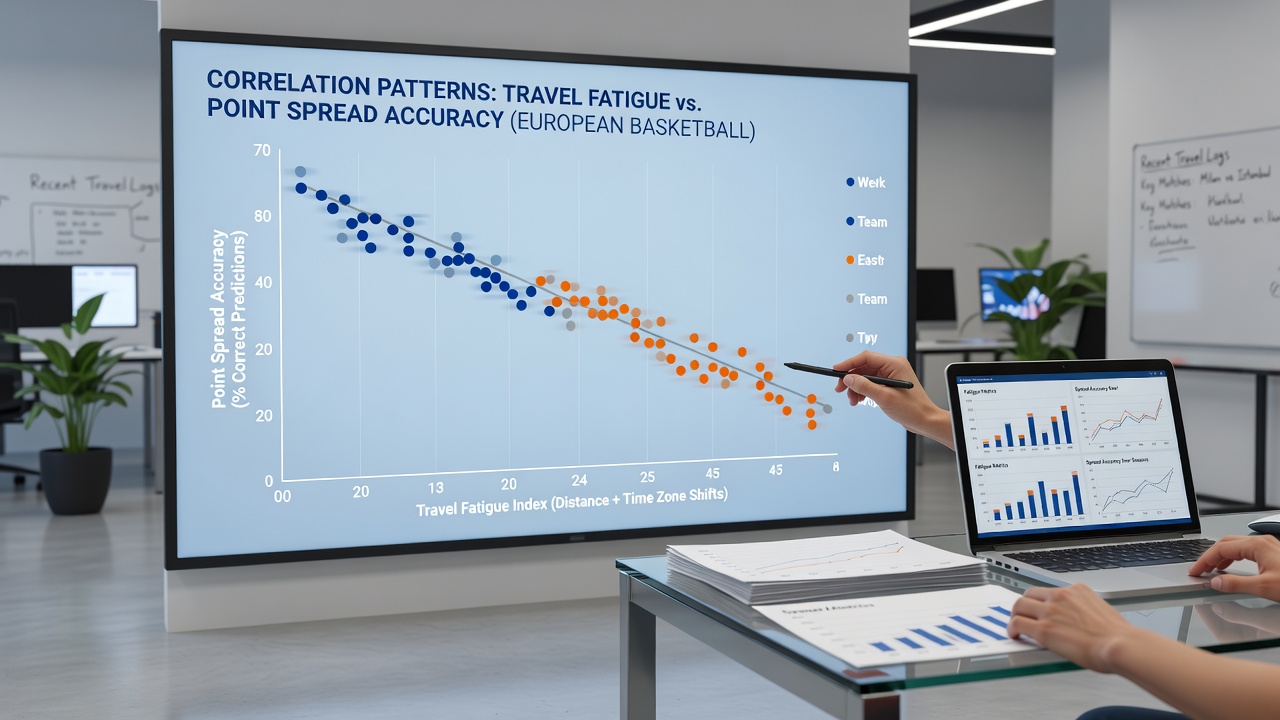
July 2026 schedules released by several leagues introduce an expanded mid-season tournament window that further compresses recovery periods for clubs participating in both continental and domestic events, prompting renewed scrutiny of how these calendar decisions may amplify existing fatigue-spread relationships. Preliminary simulations using the 2025 regression coefficients project an additional 0.9-point widening of average errors during the July cluster if current rest minimums remain unchanged.
League-Specific Comparisons and External Benchmarks
Comparative analysis with North American leagues offers useful context, although structural differences limit direct extrapolation. A EuroLeague Basketball study of schedule density notes that European teams average 1.7 trips exceeding 600 kilometers per month during the regular season, a figure higher than most NBA clubs yet lower than certain South American or Australian domestic circuits. When researchers overlay betting market data, the European sample consistently shows stronger travel-related residuals than NBA counterparts, possibly because roster depths and travel amenities differ across continents.
Observers tracking FIBA-sanctioned events have also recorded elevated error rates in national-team windows, where players arrive from distant club locations with minimal acclimatization time. These windows provide natural experiments that reinforce the correlation patterns observed in club competition, although sample sizes remain smaller and require cautious interpretation.
Implications for Modeling and Market Monitoring
Quantitative models that incorporate travel-fatigue indices demonstrate improved out-of-sample accuracy when predicting spread residuals, with mean absolute error reductions of 0.6 to 1.1 points depending on the league. Market participants monitoring line movement have begun integrating similar metrics into proprietary systems, particularly ahead of condensed playoff stretches. The patterns do not imply inefficiency sufficient for consistent profit after transaction costs, yet they highlight areas where public odds may lag behind updated fatigue calculations.
Conclusion
Longitudinal evidence across Europe's premier basketball competitions establishes a clear, quantifiable link between travel demands and deviations in point-spread accuracy, with effects scaling alongside distance, time-zone changes, and schedule compression. As leagues finalize calendars that include the July 2026 tournament block, continued monitoring will determine whether existing correlations intensify or whether adjustments in rest protocols mitigate the observed relationships. The data framework developed for these analyses offers a replicable template for other sports where geographic dispersion and fixture density intersect with betting market outcomes.