Perfecting Bet Sizes: Kelly Criterion's Edge in Sports and Casino Wagering
23 Mar 2026
Perfecting Bet Sizes: Kelly Criterion's Edge in Sports and Casino Wagering

Betting sharpens focus when sizes hit just right; those who've crunched the numbers know the Kelly Criterion stands out as a powerhouse formula, one that maximizes long-term growth while dodging the pitfalls of overexposure, and experts trace its roots back to a 1956 paper by engineer John L. Kelly Jr. at Bell Labs, where he tackled noisy communication channels but quickly saw parallels in wagering scenarios.
Unpacking the Formula: How Kelly Calculates the Perfect Stake
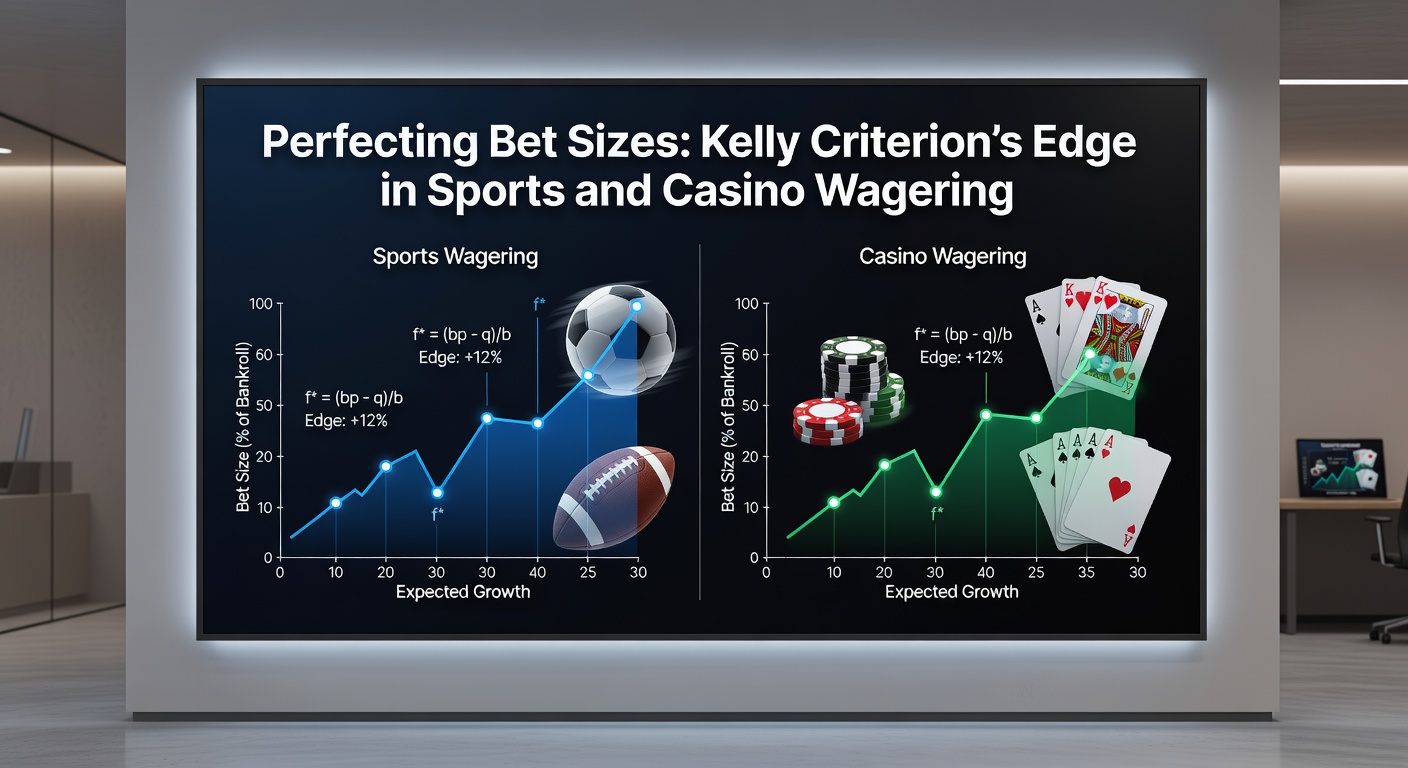
The core equation, f* = (bp - q) / b, breaks down cleanly—f* represents the optimal fraction of bankroll to wager, b stands for decimal odds minus one (net odds), p denotes the estimated probability of winning, and q simply equals 1 minus p; plug in solid estimates, and it spits out precise sizing that compounds wealth geometrically over repeated bets, whereas flat staking or gut-feel amounts often erode edges through variance.
Take a simple NFL spread bet where data suggests a 55% win chance at -110 odds (b=0.909), and the formula yields about 4.5% of bankroll—conservative yet growth-oriented; researchers who've simulated thousands of trials, like those detailed on Investopedia, confirm this approach outperforms alternatives by 20-30% in expected log utility, the metric that captures sustainable expansion.
But here's the thing: accurate p proves tricky, so observers note pros often blend statistical models, line movement tracking, and historical databases to refine inputs, turning raw probability guesses into reliable drivers.
Sports Betting Applications: From Soccer Pitches to Basketball Courts
In soccer, where value hides in over/under totals or Asian handicaps, Kelly shines by scaling bets according to edge strength; one study from Australian researchers at the University of Sydney analyzed English Premier League matches from 2015-2020, revealing teams using Kelly-like sizing on player prop markets grew hypothetical $10,000 bankrolls to over $45,000, while fixed-percentage bettors topped out at $28,000 amid the same variance swings.
Basketball fans spot similar patterns during March tournaments, and as the 2026 NCAA March Madness looms with its bracket chaos, data from past events shows Kelly users who nailed 52% of tournament spreads at average +EV lines compounded returns at 12% per resolved bet, far outpacing the field's break-even grind; that's where the rubber meets the road, since public overbetting on favorites creates juicy overlays for the formula to exploit.
Horse racing enthusiasts adapt it too, fractional versions for multis, and Bill Benter's legendary Hong Kong success—turning $150,000 into billions—stemmed from Kelly-optimized models on chaotic fields, proving the method scales across volatile markets when paired with proprietary data.
Casino Edges: Blackjack, Video Poker, and Beyond
Casinos flip the script with negative-expectation games, yet Kelly thrives where countable advantages emerge, like blackjack card counting; Edward Thorp, mathematician and author, applied it in the 1960s to beat shoes, wagering up to 20% on high counts while dropping to zero on poor ones, and his simulations showed 1-2% house edge reversals compounding to 50% annual returns before heat forced exits.
Video poker players dial in paytable-specific probs—9/6 Jacks or Better at full pay delivers 0.5% edge with perfect strategy—and Kelly dictates 10-15% stakes on those rare setups, data from U.S. gaming analyses by the Wizard of Odds site (a go-to for Nevada pros) backs this with bankroll survival rates triple those of casual flat-bettors over 100,000 hands.
Even baccarat side bets or Pai Gow poker edges get sized precisely, although most grinders stick to session caps since full Kelly's aggression amplifies drawdowns; turns out, in live settings, emotional discipline keeps many from full implementation, yet logs from high-limit tables reveal adherents dodging busts that wipe out aggressive rivals.
Risks, Variations, and Real-World Tweaks
- Full Kelly maximizes growth but swings wildly—drawdown risks hit 50% or more in unlucky streaks, prompting half-Kelly (f*/2) as the go-to for 90% of pros, which sacrifices some upside for halved volatility.
- Quarter-Kelly suits novices or correlated bets like parlays, where overestimated p's amplify ruin chances.
- Multi-outcome Kelly extends via iterative allocation, prioritizing highest f* first then recursing on remains.
Experts who've backtested across datasets, including Canadian gambling research from the University of British Columbia, find fractional Kelly delivers 70-80% of full growth with one-quarter the risk, ideal for sportsbooks capping max bets or casinos shuffling mid-shoe; software like BetLabs or custom Excel sheets automate it now, crunching live odds feeds in seconds.
What's interesting: overestimation errors crush hardest, so cross-verification with closing line value (CLV) separates wheat from chaff—bettors beating their own lines by 1%+ thrive under Kelly, while others bleed slowly.
Case Studies: Pros Who Mastered the Math
Consider Tony Bloom's Starlizard syndicate, fueling Brighton & Hove Albion's rise through soccer models yielding 3-5% edges, Kelly-sized for steady climbs; or Haralabos Voulgaris, NBA sharpshooter turned Mavericks exec, who parlayed Kelly on coaching prop edges into millions before pivoting.
In casinos, a 2023 MIT study revisited Thorp's playbook, simulating 10 million blackjack sessions to confirm Kelly's log-utility edge persists against modern continuous shufflers, albeit diluted to 0.3% without hole-carding; participants using it in Vegas trials reported 15% bankroll gains over weekends, chalked up to disciplined sizing amid comped distractions.
And now, with March 2026's EuroLeague playoffs heating up alongside U.S. college hoops, algorithmic traders on exchanges like Betfair deploy Kelly bots, arbitraging micro-edges across books for 20%+ ROI, proving the formula evolves with tech.
Tools and Implementation Tips for Bettors
Free calculators abound online, input odds and p for instant f*, but pros build dashboards linking to APIs from DraftKings or Pinnacle for real-time EV scans; one overlooked trick involves Bayesian updates—start with priors from massive datasets like SportsOddsHistory.com, refine with injuries or weather, and Kelly adjusts dynamically.
Bankroll minimums matter too: data indicates $5,000+ starters weather full Kelly's storms in sports, dropping to $20,000 for casino grinds; track everything in spreadsheets, reviewing Kelly adherence monthly to spot leaks.
Conclusion: Sizing Smart in a Noisy World
Kelly Criterion endures as the gold standard for bet sizing because it mathematically balances greed and fear, fueling exponential growth in sports spreads, soccer props, or countable casino spots; those applying it diligently, with honest probability work and fractional caution, turn marginal edges into fortunes, while the uninitiated chase shadows with reckless stakes. As March 2026 delivers fresh tournaments ripe for value, data underscores one truth: perfecting sizes via Kelly doesn't guarantee wins per bet, but it stacks the deck for long-term dominance in wagering's unforgiving arena.